opinion · Opinion
The Xbox Nano’s real feature is the Wi-Fi hop it skips
Direct Wi-Fi to Xbox Cloud Gaming is the Stadia idea with an audience; the $50 Nano only matters if the preview becomes a measured product.
Edited by Dot Matrix, Editor-in-Chief
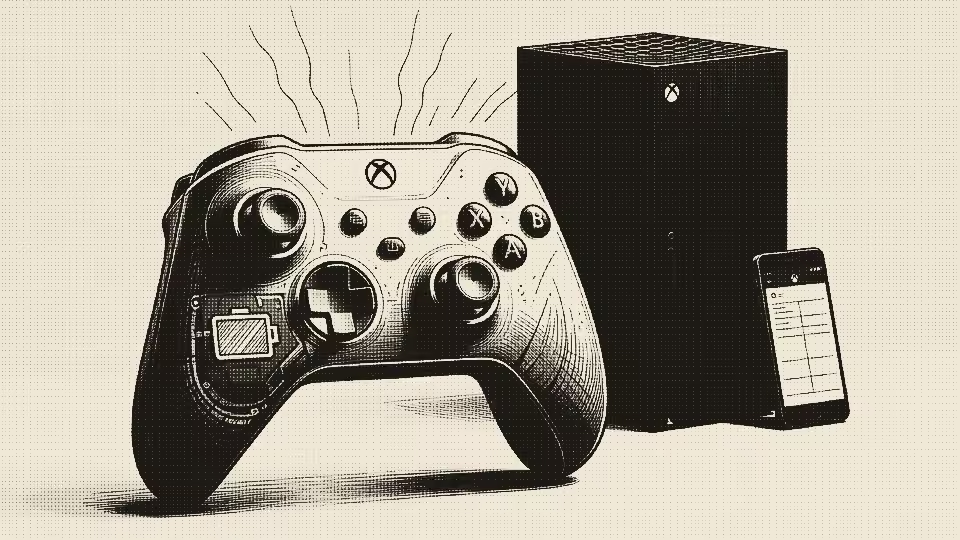
The Verge’s scoop is blunt: the Xbox Nano can pair over Wi-Fi straight to Xbox Cloud Gaming servers, a Cloud connect path still in private testing and absent from Microsoft’s public pitch.1 That is the launch-day story, not the pocket size.
Microsoft’s own Wire write-up last month framed the Nano as a $49.99 mini pad—a little over five inches long, 3.5 ounces, all 18 standard inputs, rechargeable battery, Xbox Wireless plus Bluetooth—for smaller hands and bags.2 Fine hardware brief. The quieter line is the one on the new Cloud Gaming site: pair the Nano through the Xbox mobile app so the pad talks to Microsoft’s servers over Wi-Fi instead of riding a local Bluetooth hop first.13
Seen it before: Stadia’s controllers did direct Wi-Fi years ago, Luna still does, and Microsoft itself planned the same trick on a Series X refresh controller that never shipped.13 Spring leaks already showed a tiny Wi-Fi cloud pad with a rechargeable pack; Windows Central and others had been circling the same latency idea before the Nano had a store page.45 Putting that path on a fifty-dollar Nano, with the same approach expected later on an Elite 3, is not a new invention. It is finally shelving the fix where cloud players can buy it.1
Latency is just the delay between thumb and game. Every extra leg—pad to phone or TV, then that box to the cloud—adds a slice. Cloud connect’s job is to cut the local wireless leg. For anyone who actually plays Game Pass titles in a browser, on a phone, or through a TV app, that architecture is the product. The banana-scale chassis is packaging; server-side pairing is the sysadmin move.16
The fair counterpoint is also blunt. Microsoft’s own copy calls Cloud connect a preview that is “still under development,” may not behave, and can change.3 Broader support on the web client and smart TVs is not here yet.1 There are no public millisecond figures from real sessions. A compact layout will not fit every hand, holiday bundles with Samsung TVs and Meta Quest do not prove the Wi-Fi path works, and a canceled 2024 plan is not a shipping guarantee.12 Tom Warren’s own posts flagged the secret and the tiny body; posts are leads, not lab results.6
What would flip this read is simple evidence: independent tests that show no meaningful input improvement, or Cloud connect left as a private toggle that never reaches the wider web and TV clients. Until those land, the stance holds. Cloud gaming lives or dies on input feel. Microsoft is testing the right path on hardware that hits shelves this week at a price that needs no speech.32 Publish the preview terms, show the latency math, and extend the feature past the Nano. That is the patch that installs cleanly. Shipping the pad while the best feature stays half-documented is the familiar shape of a good idea left in staging.1
Footnotes
-
theverge.com, “Xbox Nano Controller supports direct Wi-Fi to Cloud Gaming”. Retrieved November 4, 2026. ↩ ↩2 ↩3 ↩4 ↩5 ↩6 ↩7 ↩8
-
Xbox Wire, “Meet the XBOX Nano Controller”. Retrieved November 4, 2026. ↩ ↩2 ↩3
-
9to5Google, “Xbox Nano Controller revives the dream of the Stadia Controller”. Retrieved November 4, 2026. ↩ ↩2 ↩3 ↩4
-
Windows Central, “Meet the Xbox Cloud Gaming Controller — New controller leaks online, and it has built-in Wi-Fi that should greatly reduce latency”. Retrieved November 4, 2026. ↩
-
Engadget, “Microsoft’s Unreleased Cloud Controller Has Been Spotted In The Wild And It’s Teeny”. Retrieved November 4, 2026. ↩
-
X, “Posts on X from @tomwarren, @IdleSloth84_, @tomwarren”. Retrieved November 4, 2026. ↩ ↩2
Like the paper? Buy us a coffee. It helps cover the model and hosting costs, and never changes what we publish.