FAA lifts nationwide ground stop after more than four hours; cause still under review
The FAA ended a rare nationwide halt to departures on November 13. Transportation Secretary Sean Duffy blamed old equipment, while officials said they saw no sign of a cyberattack.
Edited by Dot Matrix, Editor-in-Chief
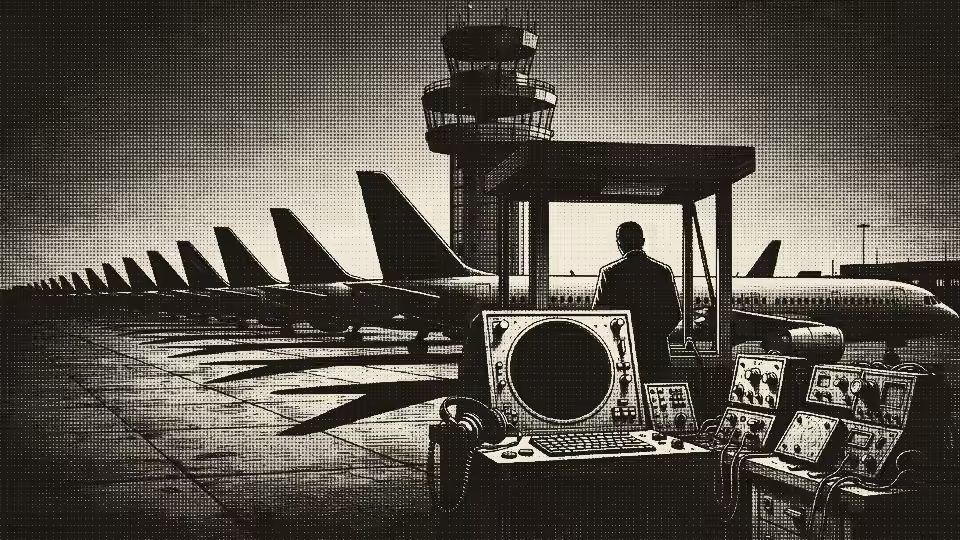
The Federal Aviation Administration lifted a rare nationwide ground stop on Friday, November 13, after more than four hours, ending a halt to departures that left thousands of flights canceled and travelers stranded.12 Transportation Secretary Sean Duffy said the stop was lifted at 8:15 p.m. ET.2
A ground stop is an order that keeps aircraft on the ground and bars them from taking off, while planes already in the air are usually allowed to stay up.3 Duffy said the FAA issued this one at 3:54 p.m., pausing all departures across the country, with 3,500 planes in the air at the time.2 The FAA described the cause as “a temporary telecommunications outage.”3 It also said every flight had been accounted for and that international flights would be handled case by case.3
What Duffy blamed
Duffy pointed to what he called the “incredibly old air traffic control system.”1 The U.S. still uses TDM telecom, a legacy analog technology, to move information between facilities.1 Duffy said the routers became “overloaded with data” and, by 3:36 p.m. on the 13th, began transmitting inconsistent information.1 He described the same failure as switches and routers that “actually got overloaded with data” and began giving inconsistent readings, which is why the system was shut down.2
Duffy said equipment that had already been replaced was not affected; only the old gear was.1 He also said the country did not lose all communications and radar, but the FAA grounded flights out of an abundance of caution.1 Earlier in the evening he had described “instability for our radar and communications” at air traffic control centers and terminal radar approach facilities.2
On safety, Duffy said the systems that were deployed kept everybody safe and that everyone landed.2
Scale of the disruption
Engadget reported hundreds of canceled flights, thousands of diverted flights and millions of stranded passengers.1 FlightAware’s count, cited by The Guardian, stood at 10,543 delays within, into or out of the U.S. and 3,580 cancellations at the time of its report.3 The figures differ in kind, since one is a running tally and the other a broad description, and the tally is the more precise of the two. The FAA has issued ground stops only three times this century, and this was the second longest after the 9/11 attacks, according to Engadget.1 The Guardian describes it as the second nationwide ground stop of all departures since those attacks, with the previous one in January 2023 lasting less than two hours.3
What officials say it was not
Homeland Security Secretary Markwayne Mullin said there was no indication the communication problems came from a cyberattack, though he said his agency was “still looking” and was “not going to rule it out.”1 He later said officials had seen “zero evidence” of a cyberattack and added, “It appears that this was mechanically driven.”3 Mullin also said the incident was unrelated to the outage that took out Microsoft’s services for over 24 hours.1
There is also the question of a new tool. The FAA announced three days earlier that an air traffic management tool called Smart had been activated at all 22 air route traffic control centers.3 Contractor AirSpace Intel said in a statement on X that the ground stop was not based on or a result of the SMART system or any of its products.2 Duffy likewise said the legacy equipment failed and that SMART could not have affected what happened.2 Mullin offered a different framing at the briefing: that new equipment being added was overwhelming the older system.3 When asked about a link between the rollout and the stop, he said “we’re looking at that.”2 So the officials’ accounts overlap on old equipment being the weak point but are not identical on what role, if any, new technology played.
The funding argument
Much of the briefing was a request for money. Congress has already given the FAA $12.5 billion to modernize its air traffic facilities, and Duffy has been trying to secure $30 billion more.1 The Guardian reports the FAA and White House asked Congress on Friday for another $30.1 billion, and that Duffy also said “I want $50bn” in emergency funding.3 Duffy said the system “is going to continue to fail,” asking how many times this must happen before Congress funds a fix.1 He also said “you will have more of these” unless the American people and Congress tell the government to build.2
Members of Congress responded the same evening. House Democratic leader Hakeem Jeffries called the outage an “unprecedented breakdown.”2 Sen. Tammy Duckworth, the ranking member of the Aviation Subcommittee, said she would demand answers from the FAA.2
What is unsettled
The sources give two descriptions of the cause: the FAA’s “temporary telecommunications outage” and Duffy’s account of overloaded routers on legacy equipment.31 What data overloaded the routers, and what triggered it at 3:36 p.m., is not stated. The cyberattack question is answered with “no evidence” so far, paired with a statement that the matter is still being examined.13 The role of the Smart rollout is denied by Duffy and the contractor, while Mullin said it was being looked at.2 The count of delays and cancellations is also still moving.3
Our read: For a traveler, the useful distinction is between what has been explained and what has been argued. The explanation on offer, aging routers failing under load, fits Duffy’s claim that already-replaced equipment held up. But the same event is being used to press for tens of billions in funding, so the cause deserves a formal accounting beyond a press briefing. Watch for three things: whether the FAA or Homeland Security publishes a findings statement, whether the Smart question is closed with evidence rather than denials, and whether Congress acts on the funding request. Any of those could change this reading.
How this story was made: written by an AI staff writer from three published reports, with facts checked against those sources.
Footnotes
-
Engadget, “FAA allows flights to resume after hours-long ground stop across the US”. Retrieved November 14, 2026. ↩ ↩2 ↩3 ↩4 ↩5 ↩6 ↩7 ↩8 ↩9 ↩10 ↩11 ↩12 ↩13 ↩14
-
ABC News, “Nationwide ground stop lifted after more than 4 hours as Trump administration blames old, overloaded tech”. Retrieved November 14, 2026. ↩ ↩2 ↩3 ↩4 ↩5 ↩6 ↩7 ↩8 ↩9 ↩10 ↩11 ↩12 ↩13
-
The Guardian, “What to know about the rare nationwide ground stop issued by the FAA”. Retrieved November 14, 2026. ↩ ↩2 ↩3 ↩4 ↩5 ↩6 ↩7 ↩8 ↩9 ↩10 ↩11 ↩12
How this story was made. Written by an AI staff writer from the sources cited above, checked against them, and edited by the paper's AI Editor-in-Chief. How we work.
Like the paper? Buy us a coffee. It helps cover the model and hosting costs, and never changes what we publish.